How I Get Sh*t Done: Part 2: When Your Plan Meets Reality
In Part 1, I covered how to evaluate and prioritise new work. Soon after I began drafting how to execute, even if things didn’t go to plan.
Then, like a rather mid-sitcom that doesn't get past its pilot, my son started his week with Chicken Pox (for the second time, who knew?!). Plus I was coming down with something myself. My carefully planned agenda, with focus blocks, sorry-to-do-this-pre-9AM-on-a-Monday stakeholder meetings, and projects went completely out the window.
This is the gap most productivity systems don't address. The beautiful tapestry of Life ✨
So, let’s talk about execution systems that helped me adapt without completely dropping the ball. Whether it's PoxGate or urgently-urgent-last-minute-but-yes-lofty-and-did-I-say-urgentGate, here's how I got through it.
When the Plan Falls Apart: A Real Week
Here’s the steps I take:
The "If Everything Burns Down" Test:
What absolutely has to happen at my realistic capacity?
Where does timing really matter, and I need to put energy into?
What can be bulleted notes, a recorded voicenote or async narrative rather than a meeting?
Front-load communication: Quick note to team and stakeholders where needed: "Reduced capacity this week, flag urgent items, assume 2-3 day delay otherwise.”
On good weeks, I’ll accomplish 80%-120% of what I set out to accomplish. PoxGate week? Maybe 40% of my original plan by Friday. But it is the 40% that matters and makes an impact. No one was blocked, everyone is fed, and I hadn't burned out maintaining impossible standards.
That's what execution systems do: help you adapt without losing sight of what matters.
The Daily Launch 🛫 (10-15 minutes)
Every morning:
Review plan for yesterday - what got done, what didn't.
Check overnight inputs - any what new urgencies?
Reality check energy - what's my actual capacity today?
Identify "the one thing" - if everything fails, what matters most? Then have two other important items.
Draw time blocks (more on this in a moment)
In any sort of -gate, the top 3 changes daily based on reality and new inputs, not original plan. That's fine. That's being agile and realistic.
The point isn't heroic achievement (no capes). It's clarity about what you're committing to today, showing up and giving best effort on where you’re actually at.
Energy-Based Time Blocking: The Practice
Every morning during my launch, I review my calendar and colour-code blocks: Blue for deep work. Orange for meetings. Yellow for admin. White for buffer/recovery. This is reviewed for the day and rest of week.
Takes 5 minutes. I'm looking for balance in those hours related to the day, but also making sure the blocks reflect the outcomes needed. You need all three to execute.
Working Within the Blocks: Pomodoro and Focus
Time blocking tells you when to work on something. Pomodoro helps you actually do the work.
I use 25-minute Pomodoro timers within my work blocks. Not because I'm a productivity zealot, (I think…), but because it gives me intent and purpose for those 25 minutes
Does it always work? Lol, truck no.
If an urgent customer issue comes in 12 minutes into a timer, I'm not ignoring it for the sake of technique purity. Also, if I'm genuinely in flow, I'm not stopping at 25 minutes because a timer dinged.
But Pomodoro gives me natural break points to check I'm still working on the right thing, or typing and clicking around into an abyss, chasing the metaphorical squirrel. Also, if I set 25 minutes to start a hefty project and it doesn't work? That's okay, leave a breadcrumb and move to my admin block.
The Context Switching Tax (And How I Minimise It)
My kryptonite isn't lack of a good plan and time, it's context switching. But it's something I can't avoid especially as a wfh mother. Also, I don't want to avoid it. I am at my best and most fulfilled when I get to ideate in the conceptual and also get into the granular. But moving from "data cleansing" to "respond to stakeholder about tricky situation" to "write strategic proposal" isn't just switching tasks. It's switching your entire mental model. And it has a cost.
My strategies:
Batch similar work where possible:
Deep blocks, usually in the morning = analytical work, building and complex problem-solving
Post-lunch = admin and tidying loose ends, preparing for conversations.
Afternoon to End of day = when most of my meetings are, so I know to be conversational and ready.
Organise communication channels by PARA: In Teams, I've structured channels to match my Projects and Areas. Channels that I'm not active in for Projects or Areas are muted.
Build in recovery time: Where possible, I take a few minutes to switch contexts. Sometimes that's a quick walk to make tea. Sometimes it's just closing my eyes for a minute. I used to think this was wasted time. Now I know it's essential time. Not always possible but essential.
Leave breadcrumbs everywhere: This is the most important one for me. When the 25 mins is up, or something that is 2x2 urgent pulls me away from work (and it will) I leave myself notes, highlights, comments in whatever I'm working in to save me spending time staring at a screen figuring it out next time, as well as jot it down.
Managing Inputs: Email, DMs, and Everything Else
Different inputs need different workflows. Here's mine:
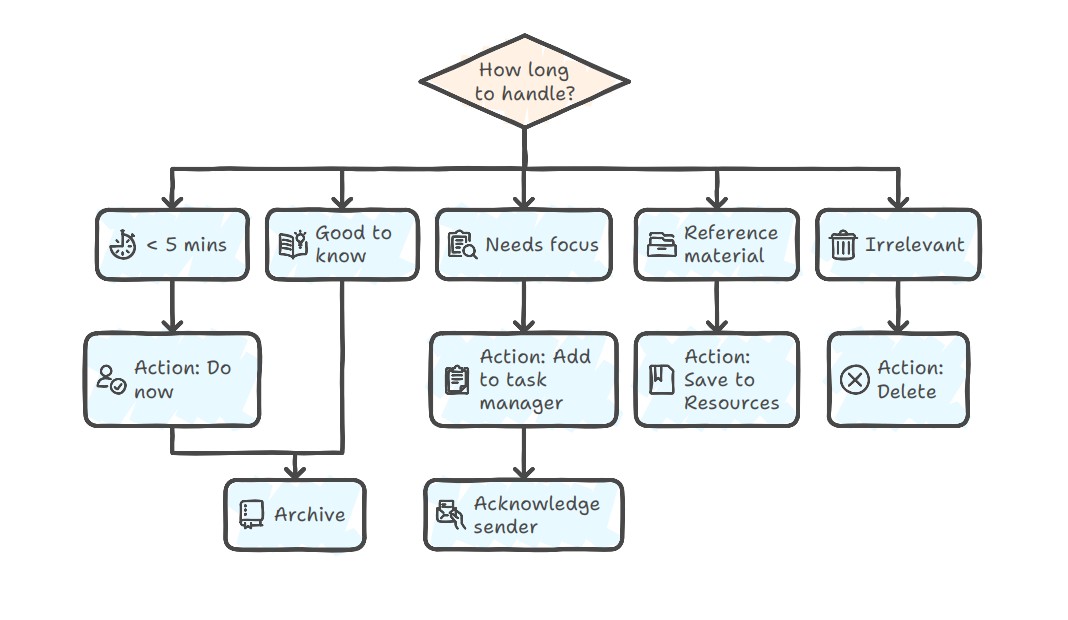
I check email at set times - usually morning, post-lunch, mid PM, and end of day - to avoid constant interruption. Exceptions for genuinely urgent things, but that's what the "Is This Actually Urgent?" test is for.
Teams :
Status shows when I'm in deep work/busy
Batch-check every 90 minutes outside focus blocks
If it needs more than three messages back-and-forth, suggest a quick call
Mute channels that aren't relevant to current projects (organised by PARA)
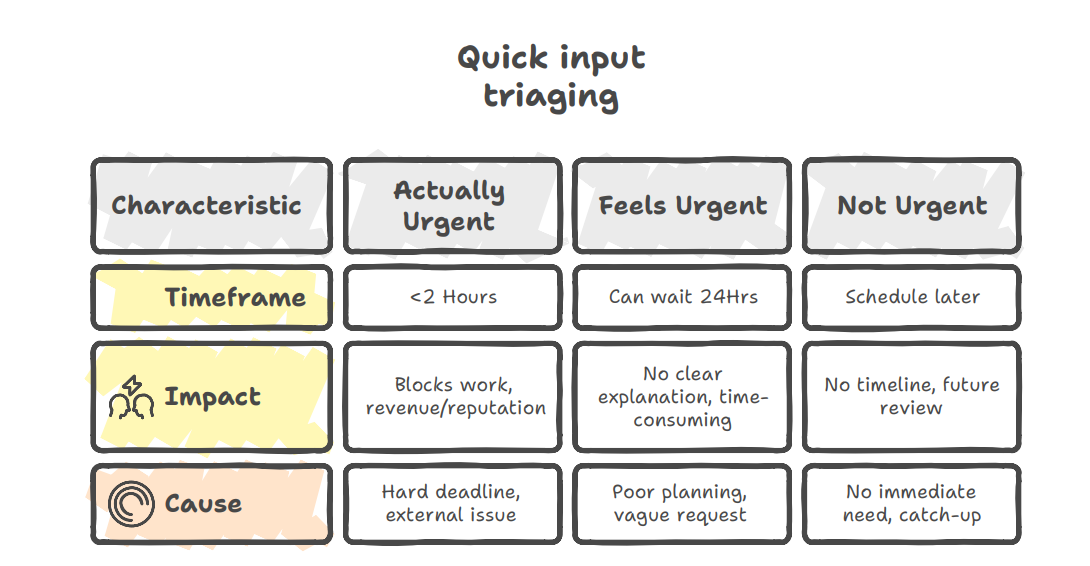
When requests come in, here's how I triage.
During Pox-gate, I got really good at asking: "What happens if I don't do this until Thursday?" Usually the answer was "nothing terrible."
The Five-Minute Shutdown Ritual
At the end of each day, unless I'm straight to Mum-duties, I like to spend five minutes:
Noting what didn't happen and what I did that was unplanned (data, not guilt)
Leaving breadcrumbs for tomorrow-me
Clearing my mental RAM
This isn't about productivity theatre. It's about being able to actually stop working. On Monday, my shutdown ritual was literally: "Got nothing done. That's fine. That workgroup tomorrow is important. I'll start that project for 25 mins tomorrow. Tomorrow exists."
Friday Planning (30 minutes)
Every Friday I then zoom out.
Reflect on the week.
What's coming in the next 2-3 weeks that needs advance planning?
How am I tracking on projects?
When's the next release date, and where are we on delivering on those?
What keeps getting bumped - does it need protection or should I drop it?
Am I making progress on what matters?
If nice-to-haves keep getting bumped, time to officially pause them and move them to Resources. All good… will pick up when they become pervasive.
Summary of What Works (Por Moi)
After years of trying different systems, here's what's actually stuck on execution:
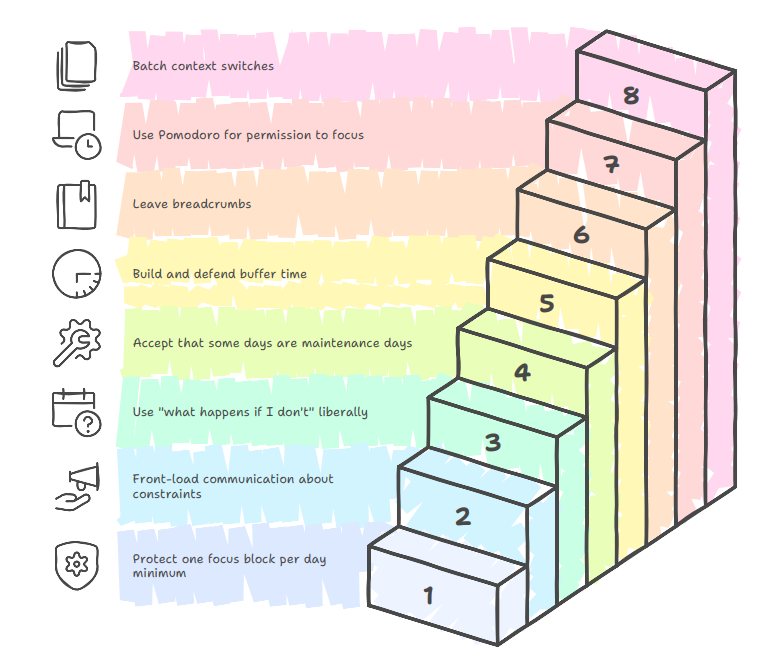
The tools don't matter as much as you think, just whatever you'll actually use at -50% capacity when everything's on fire, and your kid's in quarantine with 46 new spots but is supposed to be at the scabby stage by now, surely.
Systems can’t prevent life-chaos. But they can help you recover from it gracefully.
Finally…
Part 3 will tackle complex problem-solving frameworks for when the path forward isn't clear. Boxing method, first principles thinking, pre-mortems, and navigating ambiguity when there's no obvious right answer, knowledge is dispersed, and you’re the absolute legend who is going to figure it out.
